Brazil Cerrado SC17/18 Fine Cup
RM50.00 MYR
Tasting Note: Chocolate | Roasted Nuts | Caramel
| Varietal | Processing Method | Altitude |
| Mixed Varietal | Natural | 900-1300m |
Size: 200g/1kg
Brewing Recommendation: Filter Brews / Modern Espresso

RM50.00 MYR
Tasting Note: Chocolate | Roasted Nuts | Caramel
| Varietal | Processing Method | Altitude |
| Mixed Varietal | Natural | 900-1300m |
Size: 200g/1kg
Brewing Recommendation: Filter Brews / Modern Espresso
RM99.00 MYR
Tasting Note: Floral | Yellow Plum | Clementine | Mango | Nectarine | Mint Choc
| Varietal | Processing Method | Altitude |
| Yellow Bourbon | Yeast-Inoculated Natural | 1750M |
Size: 200g/1kg
Brewing Recommendation: Filter Brews / Modern Espresso
Yellow plum is the first thing you'll taste in this Colombian El Diviso Yellow Bourbon, produced by Nestor Lasso by steering the whole-cherry ferment with selected yeast, and the cup that comes back is clean, floral and stacked with yellow stone fruit.
This lot comes from Finca El Diviso, near Pitalito in Huila, Colombia, farmed by Nestor Lasso with his brother Adrian and partner Jhoan Vergara. They're a young, third-generation Pitalito growing family, and their coffees have turned up in World Barista Championship routines, so the bar for what lands in the bag is high.
Yellow Bourbon is a yellow-cherried form of Bourbon that first showed up in Brazil in the 1930s, the gold fruit coming from a recessive gene pair (basically Bourbon with the colour dial turned to amber). It's prized for sweetness, bright citric acidity and ripe stone-fruit notes, and it shows best above roughly 1,000 masl, which this 1,750-masl lot clears with room to spare.
Here's the nerdy bit. Instead of leaving the whole cherries to ferment on whatever wild microbes happen to be in the air (a standard natural), the cherries are inoculated with a selected yeast, Saccharomyces cerevisiae (T58), then held at around 35°C for about 80 hours at a 1:5 yeast-to-cherry ratio before drying. Think of it like using a sourdough starter instead of hoping the right bugs turn up: a known yeast steers the flavour and keeps batches consistent. The payoff is more clarity, higher acidity and more tropical, floral lift than a standard natural usually gives.
Expect yellow plum up front, then clementine, mango and nectarine, all wrapped in florals with a cool mint-chocolate finish. The mango leans tropical in a way a Malaysian palate will clock straight away. It's coffee with character, and a tidy lesson in what a controlled ferment can do.
If your shelf is all the usual washed and natural lots, order a bag of this yeast-natural online and taste what a steered ferment does differently.
Tasting Note: Black Forest Cake | Mango | Mikan | Pineapple
| Varietal | Processing Method | Altitude |
| Java | Other Processing | 1800m |
Size: 200g/1kg
Brewing Recommendation: Filter Brews / Modern Espresso
RM91.00 MYR
Tasting Note: Floral | Muscat Grape | Orange | Honey
| Varietal | Processing Method | Altitude |
| Papayo | Natural | 1750m |
Size: 200g/1kg
Brewing Recommendation: Filter Brews / Modern Espresso
This is a natural-process Colombia from Las Delicias farm in Huila, grown at 1,750 metres from the rare Papayo variety — and it drinks floral and bright, with Muscat grape, orange and a honeyed sweetness running through the cup.
Papayo is one of coffee's genuine oddities. It's named for its cherries, which grow pointy and elongated like little papayas, and its genetics are still up for debate — maybe a spontaneous Caturra or Bourbon mutation, maybe a stray Ethiopian landrace, with nobody able to confirm it without proper genetic testing. It's rare, too, grown mostly on smallholder plots concentrated around Huila.
The natural process is what pulls it all together: the whole cherry dries intact in the sun, so the fruit's sugars and aromatics soak right into the bean — which is exactly where that sweet, fruit-forward character comes from. Huila's high Andean altitude helps as well, with warm days and cool nights that slow the cherries down and concentrate the flavour. That honeyed note lands somewhere near gula melaka — no expertise required to enjoy it.
Brew it as a filter and give it room to bloom — this is coffee with character that rewards a careful pour.
Tasting Note: Fruit Tea | Mango Juice | Maple Syrup
| Varietal | Processing Method | Altitude |
| Red Caturra | Mango + cultured-yeast (Lactobacillus / S. cerevisiae) mother-culture co-ferment; ~180h sealed fermentation with mango solution, fully washed, then 20–25 days drying. | 1,730 masl |
Size: 200g/1kg
Brewing Recommendation: Filter Brews / Modern Espresso
This coffee drinks like mango juice with maple syrup sweetness underneath, because producer Rodrigo Sánchez Valencia co-fermented the pulped coffee for roughly 180 hours with a cultured mango-and-yeast "mother culture" before it was processed as a fully washed coffee (all pulps, flesh and mucilage removed at the time of drying).
Rodrigo Sánchez Valencia is a third-generation farmer at Finca Monteblanco, in San Adolfo (Vereda La Tocora), municipality of Acevedo, in the Huila highlands of southern Colombia. He's known for designer co-fermentation lots, and this is one of them. The farm harvests twice a year, June to July and October to November.
This is the engine of the cup. Over about eight days, a "mother culture" of cultivated microbes (Lactobacillus plus Saccharomyces cerevisiae, the same yeast behind bread and beer) is built up and fed with panela and mango, a bit like a sourdough starter grown for coffee instead of bread. That live culture inoculates the pulped coffee, which then ferments in sealed tanks with a mango solution for around 180 hours. The sugar level and pH are held inside a tight window so the fruit layers on top of the coffee's base rather than burying it. Only then is the lot fully washed and dried slowly for 20 to 25 days.
Caturra is a natural dwarf mutation of Bourbon found in Brazil about a century ago, capable of good cup quality at altitude but famously vulnerable to leaf rust. Red Caturra is the form that dominates Colombian planting, and on its own it leans toward chocolate, grapefruit and berry sweetness. It's a clean, dependable workhorse, which is the whole point: the ferment is what turns an ordinary cup into this one.
Expect mango juice out front, maple syrup sweetness sitting underneath (closer to gula melaka than to anything you'd pour on pancakes), and a fruit-tea lift on the finish. It reads as layered rather than artificial, which is exactly what holding that fermentation window is for.
For the discerning cup: order a bag online and taste exactly what Rodrigo's mango co-ferment does to a clean Huila Caturra.
Tasting Note: Floral | Peach | Honey | Fructose
| Varietal | Processing Method | Altitude |
| Castillo | Raisin Anaerobic Washed | 1700-1800m |
Size: 200g/1kg
Brewing Recommendation: Filter Brews / Modern Espresso
Expect honeyed sweetness, concentrated and clean, wrapped in floral, peachy lift: that is the signature of this Castillo which underwent supercritical CO2 + Raisin Anaerobic Washed process. The clever bit is that the ripe cherry is dried down to a raisin before fermentation, so the seed drinks the sweet ferment liquid back in rather than rinsing it away.
It comes from Café Granja La Esperanza, the family-run Colombian specialty producer widely credited as the first to bring Geisha to the country. The lot is grown in Quindío, one of the three departments of Colombia's Eje Cafetero (the Coffee Triangle), whose coffee landscape is a UNESCO World Heritage Site. Here the trees sit at 1,700 to 1,800m on the rich volcanic soils that give the region its reputation.
Castillo is Colombia's workhorse: bred over decades by the national coffee research centre Cenicafé and released in 2005, it crosses Caturra with the Timor Hybrid (an Arabica and Robusta cross), which hands it built-in resistance to coffee leaf rust. Think of it as a tougher immune system in plant form. It now makes up roughly 45% of Colombia's crop, the sort of everyday variety nobody writes poetry about. Which is rather the point of what happens next.
In a Raisin Anaerobic Washed process, the whole ripe cherry is first dried to a raisin form by driving off its free water. Then it ferments in sealed tanks where raisined cherry re-absorbs that fermentation liquid, carrying the sweet fruit essence into the seed instead of washing it off and discarding it the way traditional washing does. Anaerobic ferments like this tend to build pronounced sweetness and clear fruit character, which is exactly what landed in the cup.
The recorded notes are floral, peach, honey and fructose: a perfumed, fruit-forward profile that earns the "Peach & Petal" name. That honeyed sweetness sits somewhere near gula melaka in spirit, deep and rounded rather than sharp. It is proof that an everyday variety, given a clever process, can become a coffee with character.
Order a bag online, dial in a gentle pour-over, and let that honeyed sweetness open up: this Castillo rewards a brewer who pays attention.

Tasting Note: White Floral | Papaya | Pomelo | Sweet Finish
| Varietal | Processing Method | Altitude |
| Bourbon Ají | Washed | 1500-1800m |
Size: 200g/1kg
Brewing Recommendation: Filter Brews / Modern Espresso
A washed Chili Bourbon grown by Brayan Smith at Las Brisas in Huila, Colombia, grown between 1,500 and 1,800 metres. Chili Bourbon is a variety whose name says Bourbon while its genetics say newly discovered Ethiopian landrace.
Well, Chili Bourbon is not a Bourbon. When a Huila lot entered simply as “Ají” placed 6th at the 2021 Colombia Cup of Excellence, the Alliance for Coffee Excellence commissioned RD2 Vision to test the variety and published the finding: not a Bourbon, but a newly discovered Ethiopian landrace not found in many accessions, including CATIE's collection. Accessions are the catalogued reference collections where the coffee world keeps plant material on file, so that sentence is a polite way of saying nobody had this one filed anywhere.
The name came from a smell, not a lab. José Herman Salazar, the Huila producer who found the tree, caught a warm, peppery character coming off the fruit as it broke from the branch at harvest, assumed a Bourbon mutation, and called it Bourbon Ají. “Ají” is the South American word for chili. You will also see it written as Chilli Bourbon, Ají Bourbon or plain Ají, all the same plant. One thing we will not blur: that competition placing belongs to Salazar's Finca La Guaca, a different producer on a different farm, and never to this lot.
Brayan Smith is a third-generation grower who owns the farm, leads a local coffee association, and passes tools and knowledge along to the smallholder families farming around him. Las Brisas is not a one-variety place: Pink Bourbon, Geisha, Sidra, Castillo, Caturra and Chili Bourbon all grow there, and the lot reaches us through Cofinet, the Colombian exporter that represents him. Worth stating plainly, since roaster copy muddles it often: Las Brisas grows this variety, but it is not where the variety was found.
The house notes are papaya, cardamom and panela: soft tropical fruit first, a dry spice note sitting just behind it, and panela, unrefined cane sugar, holding the base through the finish.
Order a bag online and give it a slow, careful pour. This is coffee with character, and it earns a discerning cup.
RM85.00 MYR
Tasting Note: Hint of Floral | Hami Melon | Watermelon | Sweet
| Varietal | Processing Method | Altitude |
| Castillo | Other Processing | 1700-1800m |
Size: 200g/1kg
Brewing Recommendation: Filter Brews / Modern Espresso
RM102.00 MYR
This thermal-shock Tabi from Finca Los Nogales in Pitalito, Huila, Colombia drinks like a bowl of red berries lifted by pomegranate and white grape. That clean fruit is the point of the process: the Hernández family bathe the cherries hot then plunge them cold to knock back rogue microbes before fermentation, steering the cup sweeter and brighter.
Finca Los Nogales is a family farm run by the Hernández family (Oscar Fernando, Angie and Olga) in Pitalito, Huila. If the name rings a bell, it should. A Los Nogales lot placed second at the 2024 Czech Brewers Cup, and the farm supplied the decaf that won the 2024 US Brewers Cup. Both were different lots from this Tabi, but they tell you plenty about what this family's green coffee can do.
The process is Thermal Shock Anaerobic Washed, and it is as dramatic as it sounds. Right at the start, the cherries are bathed in hot water (around 80°C for roughly 20 seconds) then shocked into cold water (around 15°C). Borrowed from pasteurization, the hot phase knocks back stray microbes and switches off enzymes, while the cold snap stops the clock and locks in aromatics. The cherries are then de-pulped and fermented for about 72 to 90 hours with a yeast starter, then sun-dried for roughly two weeks. The Hernández family run this deliberately, chasing a cleaner, sweeter cup with more exotic fruit and less of the rough edge a wilder ferment can leave.
Tabi a Colombian variety bred to shrug off leaf rust, grown at 1,600 masl. Higher, cooler ground ripens cherries slowly, and slow ripening tends to pack in more sugar and cleaner acidity, which plays straight into that berry-and-grape profile.
Expect red berries out front, with pomegranate and white grape on the nose and a soft osmanthus and melon sweetness underneath. If you have ever bitten into a cold, ripe jambu air, that crisp, watery-sweet snap is the register we are talking about. Clean, juicy and a little exotic, and easy to sit with.
Add a bag to cart and see what a decorated Huila farm's fermentation experiment reads like in your own brew style.

Tasting Note: Rose | Lychee Liqueur | Cranberry | Champagne
| Varietal | Processing Method | Altitude |
| Castillo | OH anaerobic honey | 1700-1800m |
Size: 200g/1kg
Brewing Recommendation: Filter Brews / Modern Espresso
With Lychee Liqueur at its centre, rose in the aroma, and cranberry and champagne in the finish, this is a coffee with character for the flavour-curious.
This coffee comes from Finca La Margarita in Quindio, Colombia. Its varietal is Castillo, and the lot is listed at 1,700–1,800 m.
This coffee is produced under the supervision of Professor Happy from Taiwan, with what he describes as an OH-driven processing method where cell-structure of the coffees were made weak with alcohol during the processing phase, before flavours were introduced via the usual fermentation/drying period. There had been failed batches, but a few years of experimentation resulted in a surprisingly harmonious flavour combination.
Grab a bag online and take your next brew somewhere delightfully unexpected.
------------
Allergent notice: Although the coffee beans went through high temperature roasting process, there are still residual alcohol content remaining in them. One of our customers reported allergy reactions after consuming OH-driven coffee, although the reaction was mild due to minimal leftover amount.
If you're advised to avoid alcohol (even a slight amount) due to allergy or lifestyle, please consider many of our other coffees!

Tasting Note: Citrus | Raisin | Muscat Grape | Plum | Brown Sugar
| Varietal | Processing Method | Altitude |
| Caturra | Raisin anaerobic washed | 1600-1800m |
Size: 200g/1kg
Brewing Recommendation: Filter Brews / Modern Espresso
La Margarita had been doing a good job producing special processing with depth, not just single dimensional flavour profile. This time, they created a coffee with notes of muscat grape first in the cup, then citrus, raisin, plum and brown sugar alongside it.
Raisin anaerobic washed is the lot’s deliberate fruit-forward frame: fresh cherries turned into raisin form by dehydrating it, the coffee is then fermented anaerobically so that the ferment juice are re-absorbed into the dehydrated cherries (and thus stay in the flesh and gets into the seed). It is then dried under the sun with all skins and flesh removed, which constitute the washed process. Think of it as a very specific route to a cup with character.
Uneven bean colour is normal for this processing method, so let the brew do the talking.
Order a bag online and try a fruit-forward coffee that takes the scenic route.

Tasting Note: Osmanthus | Ripe Peach | Orange | Liqueur | Citrus
| Varietal | Processing Method | Altitude |
| Castillo | OH anaerobic honey | 1700-1800m |
Size: 200g/1kg
Brewing Recommendation: Filter Brews / Modern Espresso
Grown at 1,700–1,800 m and processed with an OH-driven method, this castillo has a clear osmanthus aroma and notes of ripe-peach, with orange support and a liqueur-like citrus finish. Its vendor-proprietary alcohol-driven anaerobic honey process is the intriguing bit, while the cup keeps the payoff wonderfully direct.
OH alcohol-type anaerobic honey a proprietary alcohol-driven anaerobic fermentation perfected by Professor Happy from Taiwan. The exact details of this OH method are not disclosed, so we will not pretend otherwise. The only detail we know is that alcohol were introduced during the pre-dry ferment process to help with breaking down the cell structure of the coffee, facilitating the flavour induction in latter stages.
Order a bag online and try a peach-led process adventure.
------------
Allergent notice: Although the coffee beans went through high temperature roasting process, there are still residual alcohol content remaining in them. One of our customers reported allergy reactions after consuming OH-driven coffee, although the reaction was mild due to minimal leftover amount.
If you're advised to avoid alcohol (even a slight amount) due to allergy or lifestyle, please consider many of our other coffees!
Tasting Note: Mango | Pineapple | Peach | Passion Fruit Jam
| Varietal | Processing Method | Altitude |
| Papayo, Ombligon | Other Processing | 1400m |
Size: 200g/1kg
Brewing Recommendation: Filter Brews / Modern Espresso

RM86.00 MYR
Tasting Note: Rose | Tutti Frutti | Raspberry | Syrupy
| Varietal | Processing Method | Altitude |
| Caturra | Washed Process with Wine Yeast | 1400-1550m |
Size: 200g/1kg
Brewing Recommendation: Filter Brews / Modern Espresso
Tutti Frutti leads this Colombian Caturra from Santa Monica, Quindío: a fruit-forward coffee with rose on the aroma, raspberry and a syrupy finish in the cup, and the intriguing detail of being Washed with Wine Yeast. It is a cheerful detour for anyone keen to try something a little different.
Finca Santa Mónica belongs to Jairo Arcila, a third-generation grower with Luz Helena Salazar as the farm's administrator. It's his largest property at roughly 50 hectares, sitting on volcanic soil along the Buenavista road outside Armenia, with papaya, banana and plantain growing alongside the coffee.
The experimental lots are processed and exported by Cofinet, the company his sons Carlos and Felipe founded. That's not a one-off gimmick. It's a programme, with the family's own export arm as the feedback loop.
Trivia on Co-ferment
Here's the bit we'd rather tell you than not: research suggests only about 3% of the fruit used in a co-fermentation ever reaches the cup, while selected wine yeast on its own reliably produces fruity, floral character. So the strawberry you're tasting is mostly a fermentation result the process was designed, not a flavour the berries handed over. Which, if anything, is more impressive.
Grab a bag online and try a fruit-led cup that takes your usual coffee somewhere new.

Tasting Note: Rose | Tangerine | Ripe Strawberry | Caramel Cookies
| Varietal | Processing Method | Altitude |
| Castillo | Yeast Honey with Strawberry | 1400-1550m |
Size: 200g/1kg
Brewing Recommendation: Filter Brews / Modern Espresso
Ripe strawberry is the whole point of this cup and it was engineered rather than lucked into: a Castillo from Finca Santa Mónica in Quindío, Colombia, processed as a honey with wine yeast and strawberry added to the fermentation, so tangerine on the nose opens into ripe strawberry and settles into caramel cookies.
Finca Santa Mónica belongs to Jairo Arcila, a third-generation Quindío grower, with Luz Helena Salazar as the farm's administrator. It's his largest property at roughly 50 hectares, sitting on volcanic soil along the Buenavista road outside Armenia, with papaya, banana and plantain growing alongside the coffee. The experimental lots are processed and exported by Cofinet, the company his sons Carlos and Felipe founded, which lists a whole run of Santa Mónica "Honey (Wine Yeast / fruit)" lots: strawberry, green apple, banana, passionfruit, lychee. That's not a one-off gimmick. It's a programme, with the family's own export arm as the feedback loop.
Honey means the skin comes off in a depulper but the sticky mucilage stays on the parchment through drying, so those sugars keep working on the bean instead of being rinsed away. On top of that, ripe cherry goes into a dry anaerobic fermentation with the pulp still on, and a selected wine yeast and strawberry are added during it; the cherry is then pulped and dried on raised beds with ripe strawberries laid amongst the coffee. The yeast part means a known organism runs the ferment rather than whatever happens to be floating around the farm, steering pace and aroma without adding any sugar. The strawberry is the co-ferment part, bringing a whole new sugar source into the tank.
Trivia on Co-ferment
Here's the bit we'd rather tell you than not: research suggests only about 3% of the fruit used in a co-fermentation ever reaches the cup, while selected wine yeast on its own reliably produces fruity, floral character. So the strawberry you're tasting is mostly a fermentation result the Arcilas designed, not a flavour the berries handed over. Which, if anything, is more impressive.
Order a bag online, brew it gently, and give it two or three goes to dial that strawberry right in.

RM67.00 MYR
Tasting Note: Citrus | Tropical Fruit | Pineapple | Passion Fruit Jam | Brown Sugar | Well-Balanced
| Varietal | Processing Method | Altitude |
| Caturra, Catuai | Passion Honey | 1550-1650m |
Size: 200g/1kg
Brewing Recommendation: Filter Brews / Modern Espresso
This Passion Honey processed coffee from Las Torres is built around pineapple and passion-fruit jam, with citrus and tropical fruit alongside a brown-sugar, well-balanced finish.
Las Torres in Costa Rica’s Brunca, Chirripó Valley has an altitude of 1,550–1,650 m, owned by the Ureña Rojas family. Passion Honey is this lot’s specific honey-process expression, where it is simply a controlled, extended honey process, not passionfruit co-ferment. It features Caturra and Catuai, a duo worth meeting when you fancy a cup that takes the tropical route.
Try something a little less expected: grab a bag online and chase that pineapple-led cup.
RM50.00 MYR
Tasting Note: Chocolate | Roasted Nut | Hints of Fruit | Caramel
| Blend Component | Processing Method | Component Percentage (%) |
| Brazil |
Pulped-natural |
50% |
| Ethiopia Sidama G4 | Natural | 50% |
Size: 200g / 1kg
Brewing Recommendation: Espresso-based
We have a long history of loving espresso blends with a base component of a bold, chocolatey bean like a solid Brazilian, with a fruity counterpart as a complement. It has almost always resulted in a balanced and comfortable blend that is suitable for daily consumption.
In Dyadica blend, the nutty and chocolatey notes from the Brazilian component pair well with notes of of mixed fruits from the Ethiopian Sidamo G4!
As a blend with relatively low acidity, it is perfect for drinkers who are looking forward to experiencing slightly fruity coffee without being overwhelmed by acidity.
RM81.00 MYR
Tasting Note: Rose | Strawberry | Blueberry | Grapes | Hint of Wine
| Varietal | Processing Method | Altitude |
| Heirloom | Slow-dry Anaerobic Natural | 1900-2050m |
Size: 200g/1kg
Brewing Recommendation: Filter Brews / Modern Espresso
This is a coffee that knows how to make an entrance. From the first sip, delicate rose aromas lift from the cup, followed by a rush of strawberry, blueberry, and grape sweetness, finishing with a graceful hint of red wine. If you’re drawn to coffees that feel juicy and aromatic, this is it!
The magic behind this coffee lies in its slow-dry anaerobic natural process - by fermenting the coffee in oxygen-free tanks and extending the drying time, the beans spend longer in contact with their fruit sugars. This encourages friendly yeasts and bacteria to work slowly, producing more of the natural flavor compounds that remind us of fresh fruit and flowers.
Think of it as a gentle, drawn-out fermentation where floral aromas like rose come from natural compounds also found in blossoms. The anaerobic environment promotes the creation of fruity esters, where you get juicy strawberry and blueberry notes. Finally, as the process stretches out, the beans take on a wine-like character, where sugars and acids combine into subtle flavors that echo red grapes and a splash of wine.
We want to preserve these delicate aromatics in your cup, letting the full spectrum of rose, berries, grapes, and winey depth shine through, therefore we opt to roast it light, with a relatively short development phase during roasting. It’s a flavor journey made possible only by giving nature more time to work its quiet magic.

RM71.00 MYR
Tasting Note: White Floral | Lemon | Peach | Black Tea
| Varietal | Processing Method | Altitude |
| Heirloom | Washed | 2100-2200m |
Size: 200g/1kg
Brewing Recommendation: Filter Brews / Modern Espresso

RM80.00 MYR
Tasting Note: Rose | Strawberry | Passion Fruit | Champagne | Juicy
| Varietal | Processing Method | Altitude |
| 74158 | 32-day extended natural | 2200-2300m |
Size: 200g/1kg
Brewing Recommendation: Filter Brews / Modern Espresso
This is a returning Ethiopian Sidamo natural from the Cherry village of Bensa region, slow-dried on raised beds for 32 days; it leads with strawberry, carries passion fruit alongside it, and finishes juicy with a champagne-like lift. For this coffee, whole cherries were slow-dried on raised beds for 32 days, a lovely detail to dial in around where the drying time leads to higher level of fermentation under the hot-cold cycle climate and dry weather in Ethiopia.
The Crackpots has carried this Bensa 32D natural before; this August 2026 arrival is its latest harvest, not our first go-round with the lot, and that says a lot about the impression we had on this natural processed gem from this origin.
Add a bag online, then dial in that strawberry-and-passion-fruit cup your way.
RM63.00 MYR
Tasting Note: Orange Peel | Pineapple | Orange | Dried Mango | Caramel
| Varietal | Processing Method | Altitude |
| Heirloom | Natural | 1900-2300M |
Size: 200g/1kg
Brewing Recommendation: Filter Brews / Modern Espresso
This is a natural-process Ethiopian Sidama coffee from the Chire highlands, and it leads with bright pineapple because slow-ripened, high-grown heirloom cherries were dried whole in the sun, driving their own fruit sugars deep into the bean. Orange follows close behind, sitting over a rounder weight of dried mango and caramel.
Chire is a woreda, a district, tucked inside the Sidama zone of southern Ethiopia, up in the fertile Rift Valley highlands. The cherries here ripen somewhere between 1,900 and 2,300 metres, and that matters: cool, thin highland air slows ripening right down, which gives a cherry time to build deeper sweetness and acidity before it is picked. Chire also has its own accent within greater Sidama. Where neighbouring Bensa leans strawberry-tropical and Aroresa runs toward jasmine and black tea, Chire reads nutty, dried-fruit and almost wine-like.
The lot carries the name Kenean, for Kenean (Assefa) Dukamo, second-generation Deputy CEO of Daye Bensa Coffee Export, a family-owned Sidama exporter that sources from thousands of smallholders and sun-dries its naturals on raised beds across the Bensa, Aroresa and Chire districts. Kenean Dukamo placed second in the 2022 Ethiopia Cup of Excellence, so the hands drying this coffee know exactly what they are doing.
It is a natural, or dry-processed, coffee, which simply means the whole cherry is dried intact in the sun rather than having its fruit stripped off first. As it dries, the fruit's sugars work their way into the bean, and that slow soak is where all the ripe, jammy fruit in the cup comes from. It is graded G1, the top grade for the cleanest, least-defective Ethiopian beans.
The aroma opens on orange peel, then the taste arrives tropical and fruit-forward: pineapple first, juicy and bright, with orange right on its heels. Underneath sits a deeper, heavier sweetness of dried mango and caramel, the sort of dark-sugar note a Malaysian palate might file somewhere near gula melaka. It is a natural that is all about ripe fruit and body, which is exactly what Chire and a careful sun-drying tend to give.
Order a bag online and brew it as a pour-over, that bright pineapple really opens up when you give it room to breathe.

Tasting Note: Rose | Blueberry | Sunkist Orange | White Peach
| Varietal | Processing Method | Altitude |
| Heirloom | Double anaerobic washed | 2200-2300m |
Size: 200g/1kg
Brewing Recommendation: Filter Brews / Modern Espresso
This is an Heirloom lot from a very high altitude of 2,200–2,300 m, going through a double anaerobic washed process: two sealed anaerobic stages, then dried under the sun without mucilage or skin attached to the seeds (all removed).
Washed Yirgacheffe is commonly associated with bright, clean floral and citrus top notes, so this lot’s rose and orange notes have familiar regional company while the fermentation intensifies the fruitiness.
Please note that uneven bean colour is normal for this double anaerobic washed lot because of the uneven nature of static immersion of coffee seeds in the fermentation liquid. So don't worry.
Let the cup do the talking, then see where the blueberry takes you.
Grab a bag online and try a sealed-stage Yirgacheffe twist you may not have had before.

Tasting Note: Bright Floral | Lemon | Bergamot | Lemon Cream | Dried Apricot | Black Tea
| Varietal | Processing Method | Altitude |
| Landrace | Washed | 1900-2200m |
Size: 200g/1kg
Brewing Recommendation: Filter Brews / Modern Espresso
Bergamot leads this coffee, followed by citrusy but sweet acidity that reminds us of lemon cream, with a black-tea finish. A classic result of a Washed Landrace lot from Ethiopia, this time processed in Banko Chelchele.
Gedeb is one of the woredas in the coffee trade’s wider Yirgacheffe/Gedeo region, so “Yirgacheffe” is the familiar signpost, while Gedeb gets us closer to the place. Chelchele sits around 2,000 m; one importer connects its floral-forward character with the high-elevation microclimate, deep red fertile soil, local varieties and processing practices.
Landrace means a traditional, locally adapted coffee variety shaped over time in its natural and farming environment. Think of it as coffee with a long local memory. Ethiopian landraces are generally associated with high cup quality and lower yields.
Dial it in, then grab a bag online for your next citrus-and-floral brew session.
RM71.00 MYR
Tasting Note: Malic | Mixed Berries | Chocolate | Vanilla
| Varietal | Processing Method | Altitude |
| Heirloom | Natural | 2000-2100m |
Size: 200g/1kg
Brewing Recommendation: Filter Brews / Modern Espresso
RM50.00 MYR
Tasting Note: Chocolate | Maple Syrup | Caramel
| Varietal | Processing Method | Altitude |
| Caturra & Bourbon | Washed | 1600-1700m |
Size: 200g/1kg
Brewing Recommendation: Filter Brews / Modern Espresso
Tasting Note: Chocolate | Vanilla Ice Cream | Whiskey
| Varietal | Processing Method | Altitude |
| Typica & Caturra | Sherry Cask Low-temp Washed | 1400-1700m |
Size: 200g/1kg
Brewing Recommendation: Filter Brews / Modern Espresso
This is a high-grown Honduran coffee that drinks like dessert: a big scoop of vanilla ice cream up front, chocolate settling in underneath, and a warm whiskey finish right at the back. It's a Sherry Cask Low-temp Washed lot grown from Typica and Caturra at 1,400 to 1,700 metres, and the barrel is where that boozy tail comes from.
Our house notes read vanilla ice cream, chocolate, and whiskey, and that's roughly the order you meet them. The vanilla leads, soft and creamy like soft-serve. Chocolate settles in underneath. Then, right at the back, that warm oaky whiskey hum. Dessert first, digestif last, all in one cup.
It's grown from Typica and Caturra, two old classics of the coffee world. Typica is basically the great-granddad of Arabica: a tall, low-yielding plant that trades quantity for genuinely lovely cups at altitude. Caturra is a naturally dwarfed cousin of Bourbon from Brazil, compact, and a dependable high-grown performer right across Central America, Honduras included. Old-school genetics, high-altitude payoff.
Here's where the whiskey comes from. The cherries are washed clean first, then the coffee is aged in sherry casks at low temperature, which is exactly what the name "Sherry Cask Low-temp Washed" is telling you. Slow, cool, barrel-led fermentation like this tends to build boozy, oak-tinged, almost wine-like complexity, the same family of character that anaerobic (sealed, oxygen-free) and barrel processing are known for.
It comes from Honduras, grown high up between 1,400 and 1,700 metres. That kind of altitude ripens cherries slowly and concentrates their sweetness, part of why a straightforward washed coffee can still land this rich and creamy.
Add a bag online and meet a coffee with character that runs dessert up front to whiskey nightcap at the back.
RM119.00 MYR
Tasting Note: Dark Florals | Grapes | Liqueur Chocolate | Lingering
| Varietal | Processing Method | Altitude |
| Geisha | Natural | 1620m |
Size: 200g
Brewing Recommendation: Filter Brews / Modern Espresso
74110, 74112 · 1950m
RM50.00 MYR
74110 & 74112 · 1950-2350m
RM50.00 MYR
RM83.00 MYR
Tasting Note: Elderflower | Pineapple | Passion Fruit | Blood Orange
| Varietal | Processing Method | Altitude |
| SL28, Ruiru11 | Natural | 1577m |
Size: 200g/1kg
Brewing Recommendation: Filter Brews / Modern Espresso
Kenya Kiambu Ruera Factory AA Natural is a dry-processed Kenyan in a country that washes almost everything, so the cup lands tropical and floral instead of the usual bright Kenyan snap.
Think tropical fruit salad with flowers on top. Passion fruit leads, pineapple and blood orange fill in underneath, and elderflower drifts around the edges. It's a long way from the crisp blackcurrant-and-citrus profile most people expect from Kenya, and that contrast is the whole point of this lot.
Kenya is washed-coffee country, almost by law. Nearly every cherry is delivered to a "factory" (the local word for a washing station) for wet processing, and it's actually illegal to buy unprocessed parchment straight from farmers. Leaving the whole cherry to ferment and dry on the bean, the way naturals are made, is a recent and still uncommon move here. That's what makes this one worth a detour.
This is SL28, the famous Kenyan workhorse selected back in 1935 for its standout cup at altitude (gorgeous in the glass, but low-yielding and a magnet for disease), blended with Ruiru 11, a hardy Kenyan-bred hybrid released in 1985 to shrug off leaf rust and Coffee Berry Disease. Think of Ruiru 11 as the tough, practical sibling planted to keep the trees healthy.
The AA on the label, by the way, is Kenya's top size grade: it measures how big the beans are, not how good they taste.
Interested? Add a bag to your cart and taste a Kenyan that breaks its own country's rules: passion fruit and flowers where you'd expect the usual bright snap.

RM61.00 MYR
Tasting Note: Hibiscus | Blackcurrant | Dark Berries | Red Berry Jam | Syrupy Sweetness
| Varietal | Processing Method | Altitude |
| SL28, SL34, Ruiru 11, Batian | Washed | 1600-1800m |
Size: 200g/1kg
Brewing Recommendation: Filter Brews / Modern Espresso
PB means peaberry. In Kenya, it identifies cherries in which one ovule develops instead of the usual two; the beans are physically sorted by screen size. Useful context for the curious brewer: PB is a sorting selection, not a promise that every cup must taste a certain way.
This lot comes from Wamuguma at 1,600–1,800 m. It was wet-processed at Wamuguma Factory, one of two wet mills operated by Ritho Farmers Cooperative Society in Gatundu South Sub-County, Kiambu County.
SL28, SL34, Ruiru 11 and Batian make up the varietal mix. Think of it as four different entries on the Kenyan coffee family tree: SL28 and SL34 are older selections, while Ruiru 11 and Batian were bred with disease resistance in mind. That background is interesting, though it does not prescribe this particular lot’s flavour.
Aroma moves from hibiscus and brown sugar into blackcurrant, dark berries and red berry jam, then finishes full-bodied with syrupy sweetness. For an enthusiast, that is your cue to brew with intention and let the berry notes do the talking.
Add a bag online, then dial in that blackcurrant-led cup with the attention it deserves.
Tasting Note: Blackcurrant | Plum | Hawthorn | Cedar
| Varietal | Processing Method | Altitude |
| SL34 | Washed | 1500-2000m |
Size: 200g/1kg
Brewing Recommendation: Filter Brews / Modern Espresso
Grown in Kenya's Rift Valley near Nakuru, this single-estate, SL34 AA Top reflects the region's high elevation, volcanic soils, and steady climate — conditions that encourage slow cherry development and layered flavour. Kenyan coffees have long been known for their structure and clarity, and this lot carries that reputation with quiet confidence.
The varietal, SL34, is a part of Kenya's historic SL selection, valued for its resilience at altitude and its ability to express terroir with depth and balance. Compared to other Kenyan cultivars, SL34 often lean slightly rounder in body while maintaining vibrant acidity.
In the cup, expect Hawthorn and red-berry notes, often with a blackcurrant edge, supported by a medium, structured body. As it cools, the sweetness becomes more defined, revealing layers that feel deliberate and composed rather than dramatic.

RM91.00 MYR
Tasting Note: Orange Blossom | Apple | Plum | Assam Milk Tea
| Varietal | Processing Method | Altitude |
| Gesha | Wet-ferment washed, greenhouse-dried | 1300-1400m |
Size: 200g/1kg
Brewing Recommendation: Filter Brews / Modern Espresso
This is a rare sight of a Gesha from Myanmar grown at 1,300–1,400 m, processed as a Wet-ferment washed coffee (dried in a greenhouse); it is from Pyin Oo Lwin, formerly Maymyo, has a long Arabica history and is among the Myanmar locations where Arabica was introduced in the 1930s before expanded cultivation.
“Washed” sounds a bit like laundry, but here it means the coffee’s fruit and mucilage are removed before the parchment coffee is washed and dried. That route is useful for anyone chasing contrast rather than fermentation fireworks: washed coffees commonly foreground clarity and clean, crisp acidity instead of fruit-driven ferment character.
Aroma moves from orange blossom to apple, then the taste lands on plum. The finish recalls Assam milk tea, giving this cup a soft-spoken closing note after the fruit. Try it when you want an unfamiliar coffee that still knows how to make its point.
Order a bag online and take this plum-led Myanmar Gesha somewhere new.

RM51.00 MYR
Tasting Note: Genmaicha | Black Tea | Roasted Walnut | Vanilla
| Varietal | Processing Method | Altitude |
| Syrina | Dry-ferment washed | 1200-1400m |
Size: 200g/1kg
Brewing Recommendation: Filter Brews / Modern Espresso
This is a Syrina coffee from produced by CSG in 2026 as an experimental dry-ferment washed coffee. Peaberry (single round seed) separation means the coffee seeds are sorted out based on an interesting genetic defect: the coffee seed stayed as one instead of splitting into two halves as usual.
Syrina is a hybrid Arabica selected in northern Thailand by Kaleb Jordan, with a genetically complex lineage that includes Sarchimor, Mundo Novo, Typica, Bourbon and Timor Hybrid. Think of it as a family tree with a few extra branches. Its documented history is Thai; there is no published record of how it reached Maymyo, so that part of this coffee’s story stays honestly unanswered.
Start with Black Tea, then look for roasted walnut. Genmaicha brings the aromatic cue, while vanilla sits in the mouthfeel. Washed coffees are generally associated with clarity and a clean, crisp acidity, a useful frame for paying close attention to this lot’s bean character.
A precise, traceable-feeling coffee without pretending its unknowns are solved. Brew with attention, then let the tea-like centre do the talking.
Order a bag online for the discerning cup, then take your time finding that Black Tea centre.
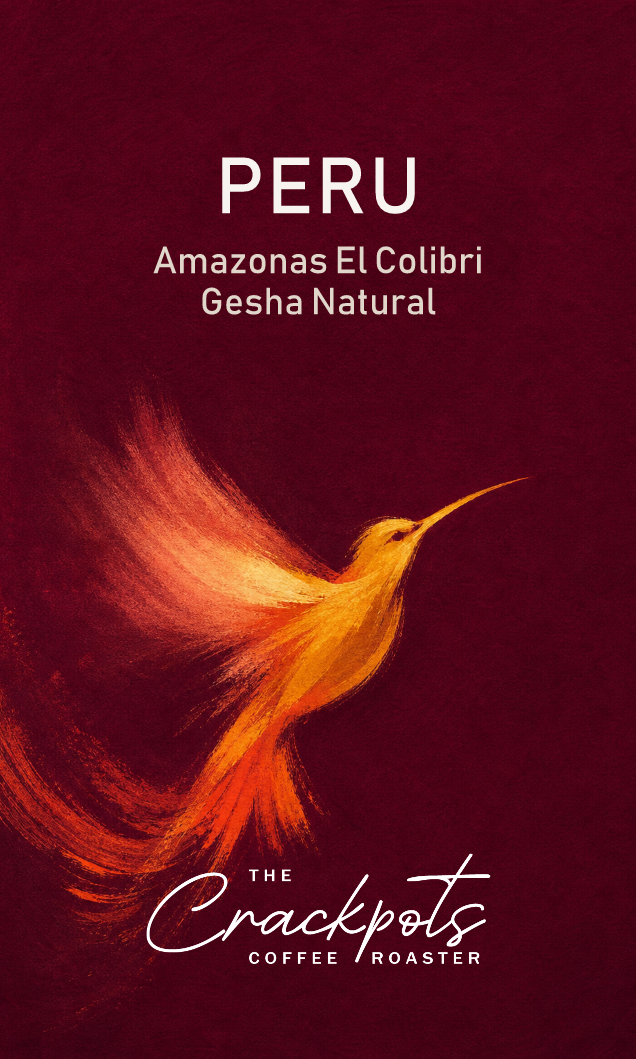
RM123.00 MYR
Tasting Note: Mulberry | Tangerine | Honey | Peach | Hint of Wine
| Varietal | Processing Method | Altitude |
| Gesha | River Natural | 1850m |
Size: 200g/1kg
Brewing Recommendation: Filter Brews / Modern Espresso
Tangerine leads this Peru Amazonas El Colibri Gesha Natural: a bright, fruit-forward natural-process cup carrying mulberry, honey, peach and a hint of wine behind the citrus. It's grown at 1850m in the Amazonas highlands of northern Peru, on El Colibri, the farm that placed #12 in Peru's 2023 Cup of Excellence.
El Colibri sits in Amazonas, the emerging specialty region of northern Peru where the Andes start tipping into rainforest. This isn't a name borrowed for a bag: the estate placed twelfth in Peru's 2023 Cup of Excellence, the national competition that ranks a country's best lots by blind jury score. When a farm places that high, a panel of independent judges has already vouched for the cup without knowing whose coffee they were tasting.
Gesha (also spelled Geisha) is the cup the whole specialty world chases, with a backstory to match. It's an Ethiopian landrace collected from Ethiopia's coffee forests in the 1930s, which travelled to Tanzania's Lyamungu research station and on to CATIE in Central America in 1953, where it was filed under accession number T2722. It stayed a research curiosity until the Peterson family entered it at Panama's Best of Panama in 2005, where it sold for over $20 a pound and set an auction record. Think of it as the variety that sat quietly in a seed bank for fifty years, then rewrote coffee's price ceiling overnight.
Here's the catch that makes this lot notable: Gesha is genuinely hard to farm. The plant is tall and low-yielding, so a grower harvests far less per tree than a workhorse variety, and it only rewards you with its famous cup when it's grown high, above roughly 1600m. It also carries only intermediate resistance to coffee leaf rust and a soft spot for nematodes, so it asks for patience and the right altitude. El Colibri's 1850m sits comfortably in that sweet spot.
This is a natural, or dry-process, coffee: the whole cherry is dried with the fruit still on, letting the bean soak up sweetness and that wine-like depth. El Colibri takes it further with a method it calls River Natural, where the cherries are fermented anaerobically (sealed away from oxygen) in flowing river water that keeps the temperature low. Cool, slow fermentation is the trick to a clean cup, because gentle temperatures hold back the boozy, funky off-notes a runaway warm ferment can throw. The cherries are then sun-dried to export standard.
Expect tangerine out front, bright and lifted, with mulberry, honey and peach filling in underneath and a hint of wine on the finish. If you know the sweet-sour pop of a ripe limau madu, that's the kind of citrus lift leading the glass. It's a sweet, fruit-forward natural that wears its provenance on its sleeve, and every cup tells a story worth following back to one Amazonas hillside.
Add a bag to your cart and give this tangerine-bright Gesha the unhurried pour-over it deserves, roasted fresh in Subang Jaya for the discerning cup.
Tasting Note: White Floral | Citrus | Grapefruit | Vanilla | Black Tea
| Varietal | Processing Method | Altitude |
| Caturra | Other Processing | 1200-1400m |
Size: 200g/1kg
Brewing Recommendation: Filter Brews / Modern Espresso